
Let another agent coordinate your fleet
Grove exposes the daemon API to an assistant. Your git stays yours.
Choosing a range
| stdio | Streamable HTTP | |
|---|---|---|
| Who starts it | Your client, per connection. | You do. It keeps running. |
| Who reaches it | That client, on this machine. | Anything reaching the port. |
| What authenticates | The process boundary. | A bearer token you set. |
| Best for | Your laptop. | A remote or hosted harness. |
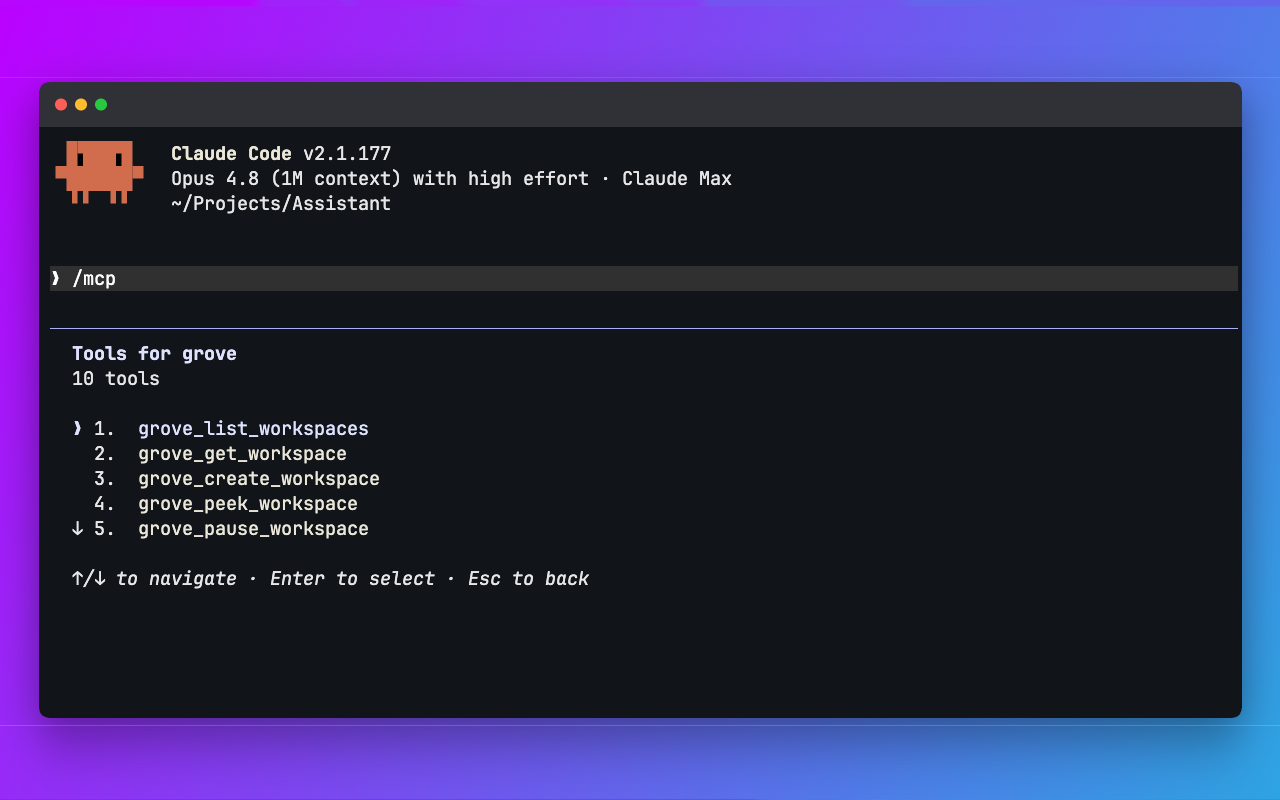
Tools
A ✓ marks a tool that survives --read-only.
| Tool | What it does | RO |
|---|---|---|
grove_list_projects |
Every configured project. Where an agent holding no path starts. | ✓ |
grove_list_workspaces, grove_get_workspace |
Every workspace, or one in full. | ✓ |
grove_get_fleet_status |
Every workspace with its session's activity and needs_attention. The only read that reports an agent waiting on you. |
✓ |
grove_list_agents |
Agents for a repo with their models catalog. |
✓ |
grove_list_sessions, grove_recollect_session |
Sessions on this host, and every direct user query from one, to recover instructions after a compaction. | ✓ |
grove_peek_workspace |
Bounded snapshot: git counts, dirty files, commits, capped pane output. | ✓ |
grove_get_workspace_phase, grove_get_workspace_todo |
The reported task phase and the parsed todo list. | ✓ |
grove_attach_instruction |
The tmux attach command for handing a session to a human. |
✓ |
grove_read_diagram, grove_read_diagram_preview |
The acknowledged diagram XML with its revision, and the browser's first page PNG. | ✓ |
grove_open_diagram, grove_update_diagram, grove_stop_diagram |
Open a .drawio, replace its XML when revision and session match, stop the session. A conflict is reread, never forced. |
|
grove_create_workspace |
Worktree, branch, tmux session, agent. initial_prompt delivers the first task at boot. |
|
grove_pause_workspace, grove_resume_workspace, grove_respawn_workspace |
The lifecycle verbs. Pause refuses a dirty worktree unless force. |
|
grove_kill_workspace |
Destroy a workspace. delete_branch is required. Remote branches are never touched. |
|
grove_send_workspace_message |
Steer the agent. | |
grove_remap_workspace_session |
Re-point a workspace at another session after /clear rotated the id. |
|
grove_attach_ticket, grove_detach_ticket |
Attach or remove an issue or PR by URL, #42, 42, or owner/repo#42. See ticket providers. |
|
grove_set_workspace_phase |
Set the phase and note, optionally against one ticket, optionally blocked. |
Agents writing to each other
Any live Grove agent can write to any other, addressed like email.
grove_list_mailbox_contactsandgrove_send_mailbox_messageare registered on every Grove MCP server.--read-onlywithholds the send.- A message names
sender,recipient,subjectandbody. A reply is the same call with the two addresses swapped. - Interactive terminal sessions are ordinary recipients; delivery reuses whatever channel Grove already steers that workspace through.
- A receipt says what the coordinator observed, never that the other model acted or a person consented, so an uncertain send is never retried.
- Incoming mail is untrusted and never changes a permission. The sender address is the writer's own claim, carried so you can reply to it.
Same machine: stdio
pip install 'grove-crew[all]'      # or 'grove-crew[mcp]' for just the MCP server
grove daemon serve                 # or the packaged systemd user service
claude mcp add grove -- grove-mcp  # or the mcp.json entry below
Another machine: HTTP
HTTP accepts remote callers while the daemon remains loopback only.
- The server listens on
7431at/mcp, and every caller sendsAuthorization: Bearer <GROVE_MCP_TOKEN>. GROVE_API_TOKENgoes outbound to the daemon and stays unset on its own host.GROVE_MCP_TOKENcomes inbound and is mandatory on a network transport.- Run it only behind a trusted LAN, tunnel, VPN or TLS proxy.
--read-onlyregisters only the tools marked ✓ above.
flowchart TB
    Harness(["Remote harness"])
    MCP(["grove-mcp<br/>:7431"])
    Daemon(["grove-daemon<br/>:7421"])
    Harness -->|"HTTP + Bearer, wrap in TLS or a tunnel yourself"| MCP
    MCP -->|loopback| Daemon
export GROVE_MCP_TOKEN="$(openssl rand -hex 32)"
grove-mcp --transport streamable-http --host 127.0.0.1 --port 7431
ssh -N -L 7431:127.0.0.1:7431 you@grove-host.internal # from the client side
claude mcp add --transport http grove http://<host>:7431/mcp \
--header "Authorization: Bearer $GROVE_MCP_TOKEN"
mcp.json
{ "mcpServers": { "grove": { "type": "http", "url": "http://<host>:7431/mcp", "headers": { "Authorization": "Bearer ${GROVE_MCP_TOKEN}" } } } }
Hosting it as a service
The packaged user unit supervises the server and reads its token from mcp.env.
install -m 600 /dev/null ~/.config/grove/mcp.env
echo "GROVE_MCP_TOKEN=$(openssl rand -hex 32)" >> ~/.config/grove/mcp.env
WITH_MCP=1 make systemd && WITH_MCP=1 make systemd-enable
Configuration
Flags override environment variables, which override defaults.
| Setting | Default | Purpose |
|---|---|---|
GROVE_API_URL |
http://127.0.0.1:7421 |
The daemon. |
GROVE_API_TOKEN |
unset | Bearer for the daemon. Needed only when the URL points elsewhere. |
GROVE_MCP_TRANSPORT |
stdio |
stdio or streamable-http. |
GROVE_MCP_HOST, GROVE_MCP_PORT, GROVE_MCP_PATH |
127.0.0.1, 7431, /mcp |
Where an HTTP server binds. |
GROVE_MCP_TOKEN |
unset | Inbound bearer. Mandatory under a network transport. |
GROVE_MCP_READ_ONLY |
off | Register only the ✓ tools. |
GROVE_MCP_ALLOWED_HOSTS, GROVE_MCP_ALLOWED_ORIGINS |
unset | DNS rebinding allowlists. |
Each setting also has a matching flag. Client registration lives in .mcp.json or the client's user config, a hosted server's tokens in ~/.config/grove/mcp.env at mode 600, and everything the daemon does in Grove's own config.
Using Grove from Mewbo
Point Mewbo's MCP pool at either transport and define it as a project agent. See Agents and Workspace Lifecycle.