
Delegate work without leaving your tracker
Comment @grove fix the flaky test on an issue and your own agent picks it up.
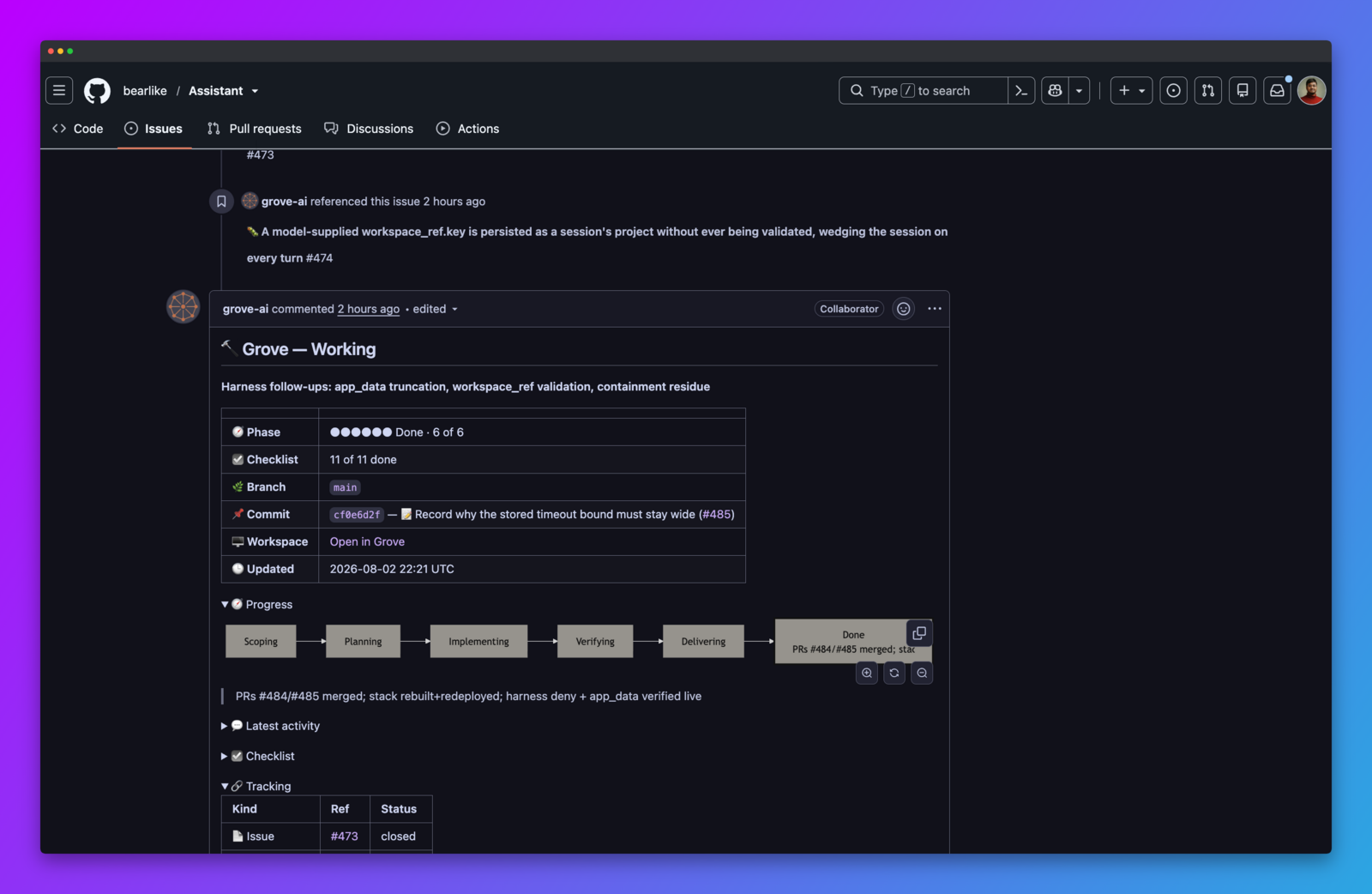
Drive agents from an issue
- One sticky comment tracks the session. The task phase, a live checklist, the tickets touched, and a link to the workspace.
- A follow up comment steers the same agent, since the executor is a long lived tmux session, not a CI job that dies with the workflow.
- Both forges draw the phase as a diagram. An agent that has not reported one gets none.
- The same comment lands on the linked pull request, so a reader on either side finds the other.
flowchart LR
  classDef done fill:#96938c,stroke:#96938c,color:#111111
  classDef now fill:#84cc16,stroke:#111111,stroke-width:3px,color:#111111
  classDef todo fill:#e4f7c0,stroke:#e4f7c0,color:#111111
  p0["Scoping"]:::done
  p1["Planning"]:::done
  p2["Implementing"]:::done
  p3["Verifying<br>running make lint"]:::now
  p4["Delivering"]:::todo
  p5["Done"]:::todo
  p0 --> p1 --> p2 --> p3 --> p4 --> p5
**Phase** ●●●●○○ Verifying (4/6) — running make lint
**Checklist**
- [x] Reproduce the flaky test
- [x] Add a retry-free fix
- [ ] Run the suite 20x to confirm
**Tracking**
- Issue #42 — open
- Pull request #43 — merged
- Open workspace
How it works
- A thin caller workflow on
issue_commentforwards the event. - Grove's composite action checks the commenter's permission, reacts 👀, and POSTs to your daemon.
- The engine creates or steers a workspace, and a status publisher rewrites the sticky comment.
- Only the caller and the action run in CI. Everything after the POST happens on your host.
flowchart TD
    Comment(["issue comment: @grove ..."]) -->|issue_comment: created| Caller[thin caller workflow]
    Caller --> Action["composite action: permission gate, react, POST"]
    Action -->|POST /issue-ops/events| Engine[daemon: issue-ops engine]
    Engine -->|create or steer| Workspace[workspace: worktree + tmux + agent]
    Workspace --> Publisher[status publisher]
    Publisher -->|sticky comment: phase diagram + todo + links| Comment
    Publisher -->|same comment, own identity| PR(["linked pull request"])
Commands
A command opens with the configured trigger, @grove by default, as the first word, matched at a word boundary and ignoring case, so @grovebot never fires.
| Comment | What happens |
|---|---|
@grove <free text> |
No workspace yet for this ticket: create one, seeded with the text as its initial prompt. One already running: steer it, as a message to the live agent. |
@grove status |
Refresh the sticky status comment now. |
@grove pause |
Pause the ticket's running workspace. |
@grove resume |
Resume a paused workspace. |
@grove stop |
Kill the ticket's workspace. |
@grove alone, or any other verb-shaped word |
A usage reply. Grove never stays silent on a malformed command. |
A prompt aimed at a paused workspace gets a reply telling you to @grove resume it first, since resume is explicit and never implied.
Assignment, the other way in
- Assign Grove's account to an issue and the pickup poll starts a workspace for it, with no comment and no CI runner.
grove tickets handover,ownedandhandbackdrive the same path by hand.issueops.pickup_max_active, default 3, bounds how many run at once, and both halves default off.- Reading assigned issues works on all three trackers. Assigning Grove's own account needs Gitea or GitHub. See the assignee is the work queue.
Showing what Grove is working, on the board
issueops.assign_botputs Grove's account on every issue a live workspace holds, so the ticket is findable with the tracker's own assignee filter by people who never open Grove.- Assignment is an output and pickup is the input. Turn on
assign_botalone for board presence with no chance of the tracker triggering an agent. - The assignment is released when the workspace ends, so the board says who is working an issue now.
- Only assignments this daemon made are released. A ticket somebody assigned by hand is left alone.
- Assigning needs repo write, which commenting does not. Where the token cannot, Grove logs the refusal and carries on.
The badges on the ticket itself
- A small footer at the bottom of the ticket's own description, because on a busy thread the status comment is a long scroll away. One badge opens the workspace, one jumps to the status comment.
- Grove owns only the region between its markers. Everything around it comes back byte for byte, and the footer is replaced, never appended.
- Both links are rebuilt on every update, so they survive a ticket moving between workspaces.
- A badge with no destination is not drawn, and editing a description needs the same repo write that assigning does.
Security model
- Write access is the default gate. A command runs only with write access or above, and
allowed_actorsadds trusted logins on top, never narrowing the default. - Bots and self replies are dropped before routing. A comment from a bot actor, or one carrying Grove's invisible signature marker, is ignored outright, so Grove can never trigger Grove.
- No fork code is ever checked out or executed.
issue_commentruns in the base repo's context with normal token permissions. - The daemon rechecks and dedupes rather than trusting the workflow. Every event is deduplicated by provider, owner, repo and comment id, so a CI retry cannot act twice, and a malformed or refused command always gets a reply.
Setup: GitHub
- The daemon binds loopback by design, so register a same host runner.
- Pin the caller to it on the default branch.
GROVE_DAEMON_URLis a variable andGROVE_DAEMON_TOKENis a secret.- Use actions/issue-ops/action.yml.
.github/workflows/grove-issue-ops.yml
name: Grove issue-ops
on:
  issue_comment:
    types: [created]

jobs:
  grove:
    runs-on: [self-hosted, grove-host]   # pinned to the host running grove daemon serve
    steps:
      - uses: bearlike/Grove/actions/issue-ops@main
        with:
          daemon-url: ${{ vars.GROVE_DAEMON_URL }}
          daemon-token: ${{ secrets.GROVE_DAEMON_TOKEN }}
Minting the daemon token
Use the pairing handshake from the dashboard.
# 1. Ask the daemon to start a pairing (run from anywhere that can reach it)
curl -s -X POST http://127.0.0.1:7421/auth/pair \
  -H 'content-type: application/json' -d '{"label":"issue-ops ci"}'
# {"challenge_id": "...", "code": "XXXX-XXXX", ...}

# 2. Approve it on the host, the same way you'd approve a new device
grove auth pending
grove auth approve <challenge-id>

# 3. Poll for the minted token (only returns it once, right after approval)
curl -s http://127.0.0.1:7421/auth/pair/<challenge-id>
# {"challenge_id": "...", "state": "consumed", "token": "grove_v1_...", ...}
Paste token into GROVE_DAEMON_TOKEN.
Setup: Gitea
- Register a
:hostrunner because the default runner cannot reach loopback. - Pin the caller to it on the default branch.
- Mint
GROVE_DAEMON_TOKENas above. - The absolute action URL supports cross repository actions.
.gitea/workflows/grove-issue-ops.yml
name: Grove issue-ops
on:
  issue_comment:
    types: [created]

jobs:
  grove:
    runs-on: [host]
    permissions:
      issues: write
      pull-requests: write
    steps:
      - uses: https://gitea.example.com/bearlike/Grove/actions/issue-ops@main
        with:
          daemon-url: ${{ vars.GROVE_DAEMON_URL }}
          daemon-token: ${{ secrets.GROVE_DAEMON_TOKEN }}
Version floors
- Gitea 1.21.6 or later is a hard requirement. Earlier versions fire
issue_commentonly on a genuine issue, never a pull request, and there is no workaround. - Gitea 1.26.0 or later in Restricted mode needs the
permissions:block above. Earlier versions parse and ignore it, so it is harmless to declare on an older instance.
Configuration
- Put settings in one
issueopssection of the configuration cascade. - The matching
tickets.giteaortickets.githubsection needsenabled,owner, andrepo. assign_botandpickup_enabledare independent. See assignment and the board above.- Trigger, driver, and agent come from configuration.
{
  "issueops": {
    "enabled": true,
    "trigger": "@grove",
    "allowed_actors": ["a-trusted-bot-account"],
    "agent": "claude",
    "update_window_seconds": 5,
    "deep_link_base_url": "https://grove.example.com"
  }
}
| Field | Default | Meaning |
|---|---|---|
enabled |
false |
Gates the sticky comment only, never routing. Commands still work with this false, and the checklist never comes back. Set it true for the live status comment. |
trigger |
"@grove" |
The mention token that must open a comment for Grove to act. |
allowed_actors |
[] |
Logins allowed to drive issue-ops whatever their repo permission. Widens the write-access default, never narrows it. |
agent |
"claude" |
Which agent from your agents list a created workspace spawns. |
prompt_template |
a built-in autonomous issue-to-PR prompt | The prompt a created workspace boots on. Placeholders {title}, {body}, {number}, {url}, {command_text}. |
update_window_seconds |
5.0 |
Coalescing window. Changes fold and flush at most once per window, so a burst of activity does not trip the forge's rate limit on comment edits. |
deep_link_base_url |
"" |
Your dashboard's base URL. Set it and the comment links to {base}/w/{workspace-id}. Empty, and it only names the workspace. |
Troubleshooting
Find the symptom in the left column.
| Symptom | Cause | Fix |
|---|---|---|
| No reaction at all | The caller is not on the default branch | Both forges load issue-event workflows from there only. Merge it in. |
| No reaction at all | Commenter lacks write access and is not in allowed_actors |
Grant write access, or add the login to issueops.allowed_actors. |
| No reaction at all | The comment was edited, not created | Only created events trigger the pipeline. An edited trigger is a silent re-fire hole. Leave a new comment. |
| No reaction at all | The trigger is misspelled, or is not the first word | It must open the comment at a word boundary (@grove ..., not hey @grove or @grovebot). Check issueops.trigger with grove config show. |
| 👀 appears, replies or status comments 403 | Gitea ≥ 1.26.0 Restricted mode needs permissions: |
Add permissions: {issues: write, pull-requests: write} to the caller. |
| Runner job times out reaching the daemon | The runner is on an isolated Docker bridge network | Use a :host-labeled act_runner (Gitea) or a same-host self-hosted runner (GitHub). |
| The same command runs twice | CI retried the delivery | Expected. The engine dedupes by (provider, owner, repo, comment_id). |
| Status comment never appears, or stops updating | The provider token lacks comment-write scope | Confirm tickets.<provider>.token_env names a token with issue-comment write access, then check the daemon log for a swallowed provider error. Publishes retry next window. |
See also
- Ticket providers and their setup.
- Task phase for the six phases.
- Authentication & pairing for the CI token handshake.
- Configuration cascade to layer settings.
- Workspace lifecycle for the verbs.