
Connect your issue tracker
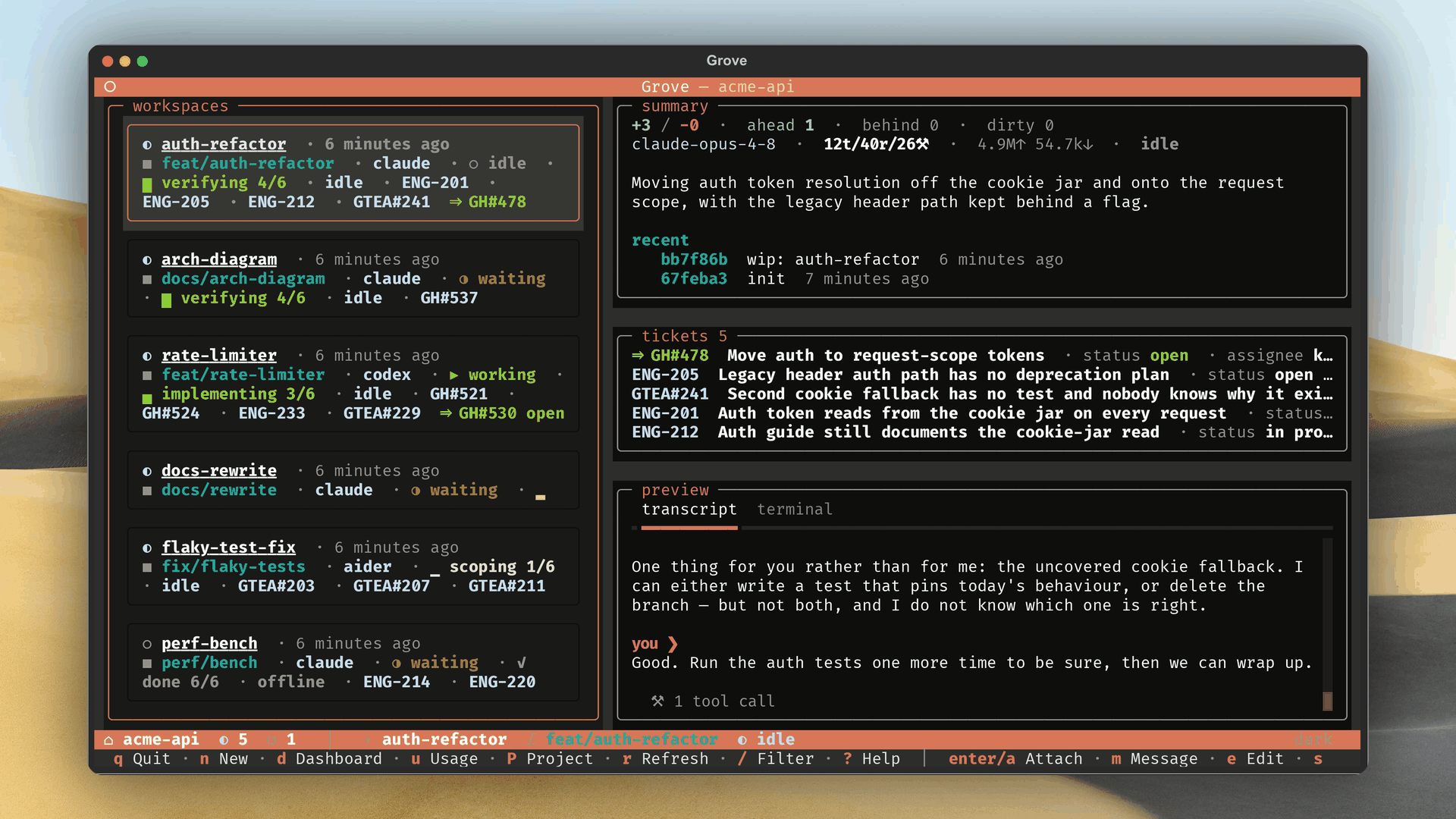
Grove links each workspace to the ticket it serves, read off the branch
name. Turn it on with a tickets section, which cascades like every
other: pin providers in project config, adjust locally. See ticket
providers for the capability itself.
All three providers default to off. Enable only what you use.
Credentials are never stored in config
Grove stores the name of an environment variable, never a token.
The secret lives in your environment under that name: config holds
token_env, your shell holds the value, safe to commit.
The tickets section
{
  "tickets": {
    "gitea":  { "enabled": false, "base_url": "https://gitea.example.com", "owner": "your-org", "repo": "your-repo", "token_env": "GROVE_GITEA_TOKEN", "branch_prefix": "" },
    "github": { "enabled": false, "base_url": "https://api.github.com",     "owner": "your-org", "repo": "your-repo", "token_env": "GROVE_GITHUB_TOKEN", "branch_prefix": "" },
    "linear": { "enabled": false, "base_url": "https://api.linear.app/graphql", "team_key": "ENG", "token_env": "GROVE_LINEAR_TOKEN" }
  }
}
Fields
| Field | Providers | Meaning |
|---|---|---|
enabled |
all | Master switch. false skips the provider in both parsing and fetch. |
base_url |
all | API root. https://api.github.com (GitHub.com) or <host>/api/v3 (GitHub Enterprise); your Gitea instance root; the Linear GraphQL endpoint. |
token_env |
all | The name of the environment variable holding the token. Not the token. |
owner |
gitea, github | Repository owner or organization, used to fetch a ticket by id. |
repo |
gitea, github | Repository name, used to fetch a ticket by id. |
team_key |
linear | Linear team key (for example ENG), the key Grove matches in branch names, so ENG-123 anywhere resolves. No owner/repo: the team key plus issue number already identify the ticket. |
branch_prefix |
gitea, github | Extra keyword recognized on top of the built-ins. For example "bug" on GitHub also matches bug-42-... as issue 42. Empty by default. Distinct from worktree.branch_prefix, which prefixes the branch names Grove generates. |
env_file |
section | Optional dotenv file the tokens are read from. Repo relative or absolute. |
env_command |
section | Optional command whose stdout is read as dotenv. Exclusive with env_file. |
Putting the token in your environment
Export the variable named by token_env before launching Grove. The daemon
reads these from its own environment, so set them where it starts:
When the token only exists later
A long running daemon reads its own environment once, at startup, so a
credential produced later (an init script, a secret manager, a rotation)
arrives too late. Point tickets at a source Grove reads on demand
instead.
{
  "tickets": {
    "env_file": ".grove/tickets.env",
    "gitea": { "enabled": true, "owner": "your-org", "repo": "your-repo", "token_env": "GROVE_GITEA_TOKEN" }
  }
}
Or resolve values without writing them to disk: any command printing dotenv to stdout works, so Grove needs to know nothing about your secret manager.
One source serves every provider, keyed by the same token_env names: the
file holds the values, the config only the path.
Resolution order
Grove resolves a token at the moment of use, never at build time, caching
nothing between. Every lookup follows the same steps, under the
token_env name:
- The configured source, if any.
env_commandruns fresh.env_fileis read fresh and parsed as dotenv. - The environment of the process running Grove.
So a token written a second ago is found immediately, a rotation needs
no restart, and env_command must stay cheap: it runs every lookup.
- No token anywhere: the provider reports
configured: false, pickers gray it out, and a call fails with a clear error, not an unauthenticated request. - A configured
env_filethat does not exist: an error, not an empty environment, so a missing credential never looks like a working one.
What a committed config may name
.grove/config.json may request a capability, never grant one: a
committed env_command is ignored (cloning must not run a command
from it), and a committed env_file must stay inside the repository.
Get the full range from user config or the gitignored
.grove/config.local.json. container follows the identical rule.
Per-provider notes
| Provider | base_url |
owner/repo |
Recognized branch forms |
|---|---|---|---|
| Gitea | Your Gitea instance root | Required, pins the repository | bare leading number (5-...), gitea-5-..., gtea-5-... |
| GitHub | https://api.github.com, or your Enterprise /api/v3 root |
Required, pins the repository | bare leading number (42-...), gh-42-... |
| Linear | Linear GraphQL endpoint | Not used, the team key plus issue number identify it | team_key anywhere in the branch (for example ENG-123); token_env holds your personal API key |
Gitea
{
  "tickets": {
    "gitea": {
      "enabled": true,
      "base_url": "https://gitea.example.com",
      "owner": "your-org",
      "repo": "your-repo",
      "token_env": "GROVE_GITEA_TOKEN"
    }
  }
}
GitHub
{
  "tickets": {
    "github": {
      "enabled": true,
      "base_url": "https://api.github.com",
      "owner": "your-org",
      "repo": "your-repo",
      "token_env": "GROVE_GITHUB_TOKEN"
    }
  }
}
Bare numbers are ambiguous when both numeric providers run
Gitea and GitHub share the numeric grammar, so 123-fix matches both
when both are enabled. Grove marks the match ambiguous and the UI
flags it. Prefer keyword forms (gh-42, gtea-5) or a distinct
branch_prefix per provider. See ticket
providers.
Linear
{
  "tickets": {
    "linear": {
      "enabled": true,
      "base_url": "https://api.linear.app/graphql",
      "team_key": "ENG",
      "token_env": "GROVE_LINEAR_TOKEN"
    }
  }
}
Where this config lives
The tickets section follows the same cascade as the rest of Grove.
| Layer | Path | Use |
|---|---|---|
| Project | <repo>/.grove/config.json |
Team baseline. Commit this (no secrets, just token_env). |
| Project-local | <repo>/.grove/config.local.json |
Per-machine overrides. Gitignored. |
| User | ${user_config_dir}/grove/config.json |
Per-user defaults for every repo. |
See also
- Ticket providers, how Grove derives and displays refs.
- Project setup, where the config files live.
- Configuration cascade, the six layers and last-wins resolution.
- Configuration reference, every field, auto-generated.